Showing posts with label Article. Show all posts

Sunday, January 29, 2012

Theory: Hidden Games and What They Tell Us

Here's a thought experiment for you. Imagine a game. It can be a sport, card game, if you're imaginative enough you could even imagine doing homework or advancing in the business world as a modeled game. Now, for whatever you're imagining, imagine how a perfect robot with 100% comprehension of the game would play in order to maximize its chances to win.

If you are like me you are not actually stopping to think right now, and I want you to, so I am going to include a couple of pictures to break up the text and try to make your brain think!


The reason that I find this so fascinating is that when you look at games at the highest level with the toughest players they are often so different as to become different games. Take Scrabble as an obvious example. A beginning scrabble player is going to spend all their time and energy trying to find the best words. The entire game is "make words worth lots of points". For quite a while progress is going to be down this path, learning that you can make words like "QI" and "ZA" to take advantage of the high-scoring letters, learning all the two-letter words to help with making long words down the sides of other words to score extra points, etc.

If you have two computers play Scrabble against each other the process of discovering every possible word that they can play takes less than a second, but the game is far far from over. When you set two computers against each other in such a way (or two extremely talented Scrabble-playing humans) the game stops being about playing the best word right now and the massive massive strategical element of the game shines through. Scrabble turns out to actually be almost impossibly tactically and strategically complex. If you have access to every available word for your turn you are still going to get outplayed by a better player over and over again, because there is so much more that you need to know to play the game excellently.

What tiles does your opponent hold? You need to calculate what her best moves on the next turn are likely to be, and work out if scoring fewer points yourself is worth it to hinder her ability to score points next turn. You can theoretically gather an awful lot of information towards what tiles your opponent could have, in much the same way that you can gather information about what might be in your opponent's hand in Magic - how long did she take to play her last turn, how many tiles did she use, did she miss any obvious possibilities (say, playing "TILE" in one place when if she had an "S" she could've played "TILES" in another, much better place), what tiles are already on the board or on your rack, etc.

What possibilities will you have next turn? If your opponent is likely to play a word which opens up high-scoring opportunities perhaps you should hold letters like "S", "T", and "E" this turn so that you will have a better chance of having a long word available next turn, or perhaps you should hold letters like "Z" and "Q" because next turn there will be a higher chance of placing them on a Triple Letter tile.

The list of variables goes on for a long long time and, in Scrabble, little effort seems to have been put into developing algorithms to address those further variables. It's easy to program a computer to quickly see two different possibilities which will score it 50 points, but very very difficult to program it to understand which of those would be better for it to play.

I think Scrabble is an example of a game which is hidden by entry-barrier. That is to say, if all people had spent two years learning to recognize word possibilities on a Scrabble board, I think the way the game was played and understood would be unrecognizable to how it is approached right now. Many other games are hidden in such a way, as are many processes in the everyday world. Understanding of games in politics - political campaigns, passing legislation, etc. - is often hindered by a lack of knowledge of how such things work, what the exact goal is, who the politicians involved are and what their motivations are. Investment is heavily underdeveloped (in my opinion) because so much of it depends simply on having enough money to start investing, which is usually either unattainable or so difficult that it takes up too much time to dedicate much energy to actually understanding investment.

Next let's talk about Chess. Chess is a game which is certainly hidden by entry-barrier. I am a terrible chess player, and there are lines that even I know up to move 20. That is to say, against certain moves by my opponents, I know the (well, a. There are often multiple possible responses) theoretically correct response move, and in some games my opponent and I trade theoretically correct moves for 20 moves before either of us actually thinks for himself. The reason that I find Chess particularly interesting is that even with the entry-barrier out of the way playing Chess is still very very very difficult. In Scrabble a slight oversight could give your opponent an extra few points. In Chess failing to see one move which could be played ten moves from now could instantly end the game in your opponent's favor. In yesterday's action at the Tata Steel supertournament, which features fourteen of the best players in the world, David Navara fell from a technically winning position to an almost losing one by missing one such seemingly innocuous move that was only two moves away.


The game of chess, I would argue, is hidden by complexity, or perhaps hidden by lack of confidence. This seems odd to say, because the point of the game, as with many other games, is that it is elegantly complex. That is what makes it a compelling game. What I am trying to say more specifically is that, were two extremely powerful computers to play each other (or even two of the world's current best players) they would quite rarely fail to see something which would allow the game to suddenly swing from winning to losing in one move. However, even for those two extremely powerful players, the lack of clarity in many positions is going to drive the game. It isn't possible to check every variation for every move, and so a potentially weaker move which contains less chance of failure will often be the one chosen.

Perfectly played chess would be impossibly beautiful, but even the best players in the world are forced to admit their imperfection with "safe" decisions, and face their imperfection against unsound attacks. The game becomes about preparing perfectly for the opening, studying rigorously for the end game, and doing as well as you can in the middle game. The most exciting games are ones in which a player studies a new move which, while not the best move, may not have been extensively prepared for by their opponent, leading to dangerous improvisational play in which one player backs their preparation at home against their opponent's ability to exploit a theoretically incorrect move.

When the best computers play there are no such crutches, and the game becomes purely about positional understanding and, well, Chess. A perfect computer will never play a weaker move just because it has calculated that it can't be extremely bad for it - it will play the strongest move and leverage any advantage it has as quickly and savagely as possible. And it will never shy away from a piece sacrifice or a dangerous tactical line because it finds the consequences unclear - it will play that move because its heuristics say it is best and trust itself to survive the explosions that follow. Basically, Chess is a game where playing the best move is often so difficult and risky to understand that it is not worth it to try, and players settle for moves which they think are simply "good enough".

The real-world "game" which strikes me as most hidden by lack of confidence or complexity is dating. The stakes are high, the rules complex, and consequences impossible to fully understand. I don't mean to say that relationships are simply a game, or that they are anything like a game, really. My point, rather, is that relationships often fail to reach their fullest, most beautiful potential, simply because the two (or more) people involved often settle into a rut of safety. How many relationships do you think suffer compared to their most ideal form because they follow basic norms instead of being the best they could possibly be at every moment? I feel that all must. It could be that one person is afraid of embarrassing themselves dancing and so the couple never tries to dance when they could have enjoyed dancing greatly if they had only given it a chance, or it could be something much more serious. Perhaps a relationship could be enhanced by open-status but neither person is willing to risk dealing with the emotions that will follow if they attempt to do so.

The last game I want to talk about is Poker. Poker is so misunderstood that people often call it gambling instead of calling it a game, or argue that it is a "game of chance" instead of a "game of skill". This is because Poker is a game which is hidden by variance. If I went to play at a casino for a few hours I might play 200 hands. If I look at any random collection of 200 hands from my Poker career the results could be just about anything. Maybe I win $200, maybe I lose $4,000. If I look at a large sample of hands though my Poker career (and that of other winning cash-game players) looks like this:


That Poker is so hidden by variance is actually a main reason that it can be so profitable. If players knew from the second they sat down at a table that they were going to lose $200 they would probably just choose not to sit down, but when players are expected to lose $200 they not only have no way to calculate that fact for sure, but there's also a chance they'll win money instead, so it can still be fun for them, and they sit down at the table, and on average they lose $200, some of which ends up in the pockets of people who are using Poker to make a living.

Unfortunately, hiding results due to variance also makes Poker hugely misunderstood. One thing that variance does is damage the way that the game is played; people make bad plays over and over again because they have no way of actually knowing that they are bad.

Whether Poker is played perfectly or not (or even well or not) is not a crucial point for humanity, but the stakes in the real world in situations hidden by variance can be much much much higher. What if instead of a hand of Poker, game theory was being applied to a war? Misunderstanding the actual consequences of actions because you are basing your understanding of them on past results which were in fact unlikely could cost countless lives. On a smaller scale, what if you have massive potential that you are not realizing because you've misread results of your actions? Maybe the girl you were meant to marry was busy the two times you called her and you thought she wasn't interested and never spoke with her again, or maybe you had a bad experience traveling to Fiji and because of it you don't travel much anymore. Humans are massively predisposed towards linking results to their actions causally and strictly, and they give far too great a weight to negative results compared to positive results in most situations. When our brains were evolving, way back when we were hunter-gatherers, a bad outcome could easily mean being eaten by a tiger, while a good outcome only meant eating for a day. In modern society we can much more easily afford to fail and don't have to suffer such absurdly heavy consequences if we do, so we should be willing to take greater risks.

As you go about your life, keep in mind that you are imperfect, and that, for whatever you are doing, even the best person in the world would be imperfect. Try to keep in mind how that might hold you back, and do your best to understand how you can maximize your potential and enjoyment of the world. Games are great fun, but life is always the most important thing, and if you're not applying what you learn from games and about game playing to your life in general you're missing out on a great source of inspiration, intuition, and wisdom.

Friday, December 2, 2011

Theory: Burning Vengeance

Since Innistrad “Block” Constructed became a thing I’ve recorded 35 MODO matches (six dailies and a premier event) piloting Burning Vengeance with a 77% winrate. You can see them all at my blog (hey guys that is here!). That includes 2-1 against monored, 1-0 against RW (not a great matchup, but the deck is a relatively recent one), 3-2 against GW, 3-2 against GBR, and 3-3 against URg “venganceless vengeance”, which has gone completely out of style, and a 16-0 record against other decks including a somewhat respectable 100% winrate over the course of nine mirror matches.

I have various things to say, and now I am going to say them. By typing. How novel. I am grumpy, deal with it.

First, it is embarrassing to humanity that after a year of getting beaten up by Squadron Hawk people didn’t instantly realize that Doomed Traveler was a gigantic bomb. I am among those people.

Now, Burning Vengeance. I am going to specifically address people who play this deck horribly, and people who play against this deck horribly. I am one of those people, but I do it a little less horribly than most. You may or may not be one of those people. If you aren’t it is probably because you are not trying.

The first thing to realize about Burning Vengeance is that it’s counterburn. It is not Burning Vengeance. Burning Vengeance is a card which deals two damage to things sometimes, counterburn is an archetype that has been pillaging villages by exploiting tiny amounts of marginal card advantage since approximately 1046 CE. All the card Burning Vengeance does is give the deck great inevitability and another good source of advantage.

This means a few things. The first thing it means is that if you are playing an aggro deck and putting Naturalize effects in your deck you are literally taking aggressive threats out of your aggro deck in order to try to play control against counterburn. Nice. Special exception for Silverchase Fox of course, what a giant hero.

If you are UG graveyard and you are putting Naturalize effects in your deck you’re not looking so hot either. Burning Vengeance does not do a great job of killing 14/14 creatures or millions of spiders. Congratulations on burning a draw step to defend your Avacyn’s Pilgrim from T4 onwards though. Oh it died to Geistflame.

The only deck that can convincingly play Naturalize effects against Burning Vengeance is Burning Vengeance. This is because Burning Vengeance is the only deck in this format that has any chance at all of outperforming Burning Vengeance in a late game. I would say it has a 50-50 shot.

In fact, the fact that both players have four Snapcasters and infinity card draw and tap out every turn means that with a couple of Naturalizes in the deck Burning Vengeance never ever stays on the table. This means you should board out your Burning Vengeances in the mirror. It does not mean you should board in Witchbane Orb, oh my god what are you thinking.

A second thing this means is that Burning Vengeance, which is actually counterburn, can kill you however the fuck it wants. It is the ultimate greifer deck. If I want I can board in Runic Repetition, Memory’s Journey, and Lost in the Mist, and counter every spell you cast until you deck yourself with your draw step. I can hit you ten times with a Snapcaster Mage. If you gain 120 life with Gnaw to the Bone I can hit you sixty times with a Snapcaster Mage. I can play one copy of Garruk and deal 90 damage to you with it in ten turns. Ninety. For four mana. I can deck you with Nephalia Drownyard while watching the Colbert Report.

If you are playing Burning Vengeance and you do not have diverse win conditions available to your deck you are sort of missing the point. Drownyard is almost free, Garruk is a straight up improvement, Memory’s Journey/Runic Repetition is almost never actually better than Memory’s Journey x2 but it is way cuter and everybody likes cute things.
If you are playing against Burning Vengeance and you are boarding in Witchbane Orbs and Naturalizes with no way to actually keep up in the lategame that you are attempting to set up by bringing in those cards you do not deserve the second half of this conditional. Enjoy losing games of Magic with your groundbreaking strategy.

I used to think Devil’s Play was really good too. It’s not. Take them out of your deck and enjoy winning more.


Yes, I managed to win that game anyway, then I put good cards in my deck.

Good cards in Burning Vengeance are cards which perform well for their manacost, because, being counterburn, the entire deck is about leveraging mana every turn to create and nurture a marginal advantage which eventually becomes absolutely insurmountable. These cards include Geistflame (x4) and Silent Departure (x4). They do not include Devil’s Play (x1???????? x0?... yeah, that).

Hit every land drop. Tap out to hit your land drop. Let your opponent hit you to one life instead of casting Blasphemous Act to hit your land drop. Eventually you will become a lot better at Magic and be able to correctly identify spots where it is not correct to cast Desperate Ravings frantically trying to play that precious precious land. Also take Blasphemous Act out of your deck.

This is counterburn, you trade 0.9 for 1 with all their threats. If Blasphemous Act costs less than eight you are losing. Probably you are losing because your deck is full of Blasphemous Acts and Devil’s Plays. The one time you want Blasphemous Act is when they have Geist-Honored Monk. Rolling Temblor is passable, but pretty bad too.

Don’t put Geist of Saint Traft in your deck. As Burning Vengeance or against it. Most of the times I see it getting boarded in as “tech” it’s into a manabase which casts it turn nine on average and the person boarding it in took out all their creature removal so it trades with a Snapcaster Mage. Don’t board in Geist and leave in your creature removal either, by the way.

Common Misconceptions:

“Burning Vengeance is the most fragile deck in the format” (boards in Naturalize and Witchbane Orb)
- No.
- I cast Garruk and you die.

“All you have to do is get out of Devil’s Play range”
- No.
- I cast Garruk and you die.

“Purify the Grave is good against you”
- It would be if you were not white red aggro. Like, maybe if you could put cards in your yard, or draw multiple cards per turn.
- “It removes two of your cards from your graveyard!”
- Uh… it removes one of your cards from your hand.
- “You cannot flashback cards so you OW MY FACE ONE HUNDRED WOOOOOLVES”.

The most important thing to realize:

To beat Burning Vengeance you simply don’t let it get to the lategame. This means you absolutely do not put Naturalize in your deck. Why would you want to take it to the lategame. Wr aggro preboard is the most fearsome matchup for Burning Vengeance, although it improves dramatically postboard because they make their deck much worse. Deal damage with creatures, then burn once they stabilize. Simple. All the other matchups are between 60 and 99% in Burning Vengeance’s favor (I don’t want to say UG is 100% in Burning Vengeance’s favor because it seems unrealistic but it actually is, so).

The next important thing to realize:

Burning Vengeance is very very hard to play correctly. If you’re not willing to think really hard and be extremely wrong a lot and fight correctly for tiny tiny advantages you are going to lose a lot to yourself. Not to yourself as in to your deck, to yourself as in to yourself. The person piloting the deck. If you want to have the highest possible winrate in this format get really good at magic, play counterburn (you barely even need to put Burning Vengeance in the deck, to be honest), and don’t get paired against Wr very often.

P.S. Wr is still 40%+ for you if you play well. Good luck!

P.P.S.

4 Hinterland Harbor
4 Sulfur Falls
4 Silent Departure
1 Woodland Cemetery
1 Nephalia Drownyard
7 Mountain
5 Island
4 Shimmering Grotto

2 Think Twice
2 Think Twice
2 Rolling Temblor
1 Garruk Relentless
4 Snapcaster Mage
4 Desperate Ravings
1 Harvest Pyre
4 Geistflame
2 Forbidden Alchemy
4 Burning Vengeance
4 Dissipate

Sideboard
1 Olivia Voldaren
3 Memory's Journey
1 Witchbane Orb
2 Garruk Relentless
1 Rolling Temblor
2 Blasphemous Act
3 Tree of Redemption
2 Naturalize

P.P.P.S. Don’t put Olivia main; half of the deck is blanking their creature removal.

P.P.P.P.S. I'm not going to add an entire sideboarding guide, but basically you want to lose Alchemy and Dissipate against fast decks in favor of removal. Against GW you want Olivia and against Wr you want Tree (and maaaaaybe Witchbane Orb, it might not be right at all). Against control decks you usually want to drop Geistflame before Silent Departure (even against UG, since you board into 3 Rolling Temblors to kill their mana dorks), and you want to bring in Garruk, Memory's Journey if they use their graveyard a ton, and Olivia if they cannot kill her. Naturalize comes in x2 for the mirror and x1 for decks which are going to board in Witchbane Orb and Nevermore unless you're okay with just killing them with Snapcasters and Garruk, which is fine too.

Tuesday, October 4, 2011

Theory: Making Mistakes

I just read a great article in Wired, which you can read here. The basic idea is this:
A new study, forthcoming in Psychological Science, and led by Jason Moser at Michigan State University, expands on this important concept. The question at the heart of the paper is simple: Why are some people so much more effective at learning from their mistakes? After all, everybody screws up. The important part is what happens next. Do we ignore the mistake, brushing it aside for the sake of our self-confidence? Or do we investigate the error, seeking to learn from the snafu?
Turns out that learning from your mistakes comes from your mind and your mindset. The longer you dwell on a mistake positively the more you will learn from it, and the more you think of your own capabilities as capable of growing through learning rather than as a set level of intelligence or aptitude the more you will learn further. The idea that you are working hard to succeed is much more valuable to learning than the idea that you are succeeding because you are smart; the latter idea actually discourages you from learning because you avoid taking risks to maintain the appearance of intelligence.

I want to add one thing to this article: Take risks! Make mistakes! The article talked in depth about how our responses to mistakes can help us learn, but didn't make any suggestions on how we could make them. Mistakes happen all the time, sure, but you can accelerate your learning greatly by putting yourself in situations where you're making them more and more. In Magic this could mean playing a deck or format that you're not used to, trying to build your own deck, and so on. If you're drafting with a friend and they tell you they don't think a card is a good pick but you disagree, probably the best thing you can do for yourself is take the card, play the card, and find out why it isn't as good as you thought it was. Get your friend to help. Any time you ever think something is a good idea in Magic but other people tell you it isn't just do it. If it is bad you'll find out why and know not to do it again, and if it isn't bad, well, you just found out something new about Magic, time to try to convince your friends.

Wednesday, September 28, 2011

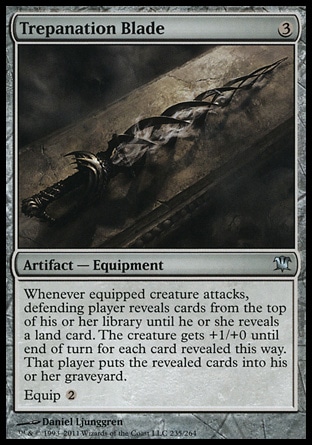
Theory: Trepanation Blade, a crash-course in probability

(or, how fucking complicated is Magic, eh?)

In this article I will answer the question of what the average damage [card]Trepanation Blade[/card] is expected to do is, and all that fun stuff. I'm also going to talk about other stuff that is more interesting about the card than just the average damage.

Suppose that an opponent started the game with 40 cards including 17 lands. By the time we're swinging with [card]Trepanation Blade[/card] we're looking at, at most, 28 cards in his deck and probably around 12 lands remaining (on average he'll draw 5.1 lands in the first 12 cards).

So we swing. Here's what happens:


I've made a spreadsheet which you can download from Google docs and see all the data for any number of cards in deck and lands in deck between 0 and 60 just by editing those two numbers. It shows the expected number of cards milled, the probability of each number of cards milled, the number of spells that will be left in the deck. You can find the spreadsheet here. If it doesn't play well with your own excel software you can always upload it into google docs again on your own google docs account and play with it there.

The thing that I think is most important about this card (which I don't consider exciting or even terribly playable) is that it's variable. Because of this it's hard to simply analyze it using its average effect. If your opponent is on seven life and you have [card]Trepanation Blade[/card] on a two power creature you need to know how often you activate for five or more, not what your average value on one activation is. Cards like this create a lot of variance in the game, but if you understand the odds you can use them to work out the best play, weighing, say, the chance of activating for five or more against the chance of topdecking one of three outs if you hold back to chump block. Once you know the numbers it's a simple math equation.

The coolest thing? [card]Trepanation Blade[/card] is pretty awful, but in a pinch you could use this spreadsheet for other cards with similar effects like [card]Spoils of the Vault[/card] and [card]Goblin Charbelcher[/card]. For example, with [card]Spoils of the Vault[/card] simply replace the number of lands in your deck with the number of the card you're searching for and you'll see all the possible numbers of cards you could reveal before finding it and how likely this will be. Enjoy!

The spreadsheet:


Set up for a fairly standard [card]Spoils of the Vault[/card] situation:


PS Activating this card does not, on average, change the chance that your opponent will draw a land/non-land next turn at all.