The top chart shows the probability that [card]Delver of Secrets[/card] will have flipped each turn assuming you play it turn one in Limited given a certain number of instants/sorceries in your deck shown in the bar at top. The second chart shows the expected damage it will do with that many instants/sorceries as compared to [card]Moon Heron[/card]. In actuality [card]Delver of Secrets[/card] outperforms [card]Moon Heron[/card] in a few other ways - it costs U rather than 3U, can attack as a 1/1 or block as a 1/1, is human for interactions with Equipment and [card]Moonmist[/card] (though [card]Moonmist[/card] can be a downside as well with the flipped side still being human), and occasionally has a looter-esque interaction with [card]Deranged Assistant[/card]. On the other hand if [card]Delver of Secrets[/card] doesn't get played on turn one it will not perform as favorably.
Twitch Stream
Showing posts with label Graph. Show all posts
Tuesday, October 25, 2011
Theory: Delver of Secrets
Friday, October 21, 2011
Theory: ISD Creatures by the Numbers
When a graph represents playability this is a rating I have given to the card between zero and one to represent its value in limited. My ratings are heavily influenced by those of channelfireball.com, but differ in many ways to represent my personal evaluation of the format after ten drafts. I've included a few of my own conclusions from this analysis below the graphs.
Feel free to download the spreadsheet which contains my ratings and the graphs pictured here. If you wish to change the ratings of the cards to reflect your own opinions the graphs will update automatically as you do so.


My thoughts:
Feel free to download the spreadsheet which contains my ratings and the graphs pictured here. If you wish to change the ratings of the cards to reflect your own opinions the graphs will update automatically as you do so.
For power/toughness of double-faced cards I simply approximated effect by averaging the sides. For [card]Lumberknot[/card] I think I just said it was a 3/3.
My thoughts:
1) Wow, Black creatures really suck.
2) Red and Blue often feel like a natural pairing in draft, but drafting them together will leave you dangerously short of two-drops. Other than make me not want to draft UR this makes me do two things. Firstly, this makes me value [card]Deranged Assistant[/card] and [card]Stitcher's Apprentice[/card] even higher than I was before. Secondly, it makes me less excited about cards like [card]Harvest Pyre[/card] and [card]Brimstone Volley[/card] in this color combination, as they fail to help your curve and I feel will often need to be directed at a two drop after already taking a swing or two from it.
3) I guess mostly it looks like I don't want to draft UR.
4) Green and White come out of the gates smashing face, and Green has an impressive late-game as well. I've found Green to be a very solid pairing with Blue, and the graphs support this hypothesis as the Green and Blue complement each other, each filling out weak spots in the others' curve. I've also found Blue and White to work well together in a more aggressive role; again this makes sense looking at the graphs. Green and White put together will also complement each other very well, you have a choice between drafting a very aggressive low-curve deck, and drafting a full curve filling in Green's 3-slot with White cards and repairing White's top-end with Green cards.
5) [card]Gallows Warden[/card] seems like he will almost never have a deck I want to put him in. As far as what each color wants Blue and White would be well-served if they got to do a little switcheroo and White got [card]Battleground Geist[/card] instead to complement its beaters and first strike spirit.
6) There is really close to no support for a [card]Bloodcrazed Neonate[/card] deck. This makes me sad. Maybe if you get insane depth in Green or White you could pair it with a little Red and play a slith or two. The problem is that almost all of the quality creatures in red are so expensive.
7) The graphs should've stopped at six on the x-axis. My thoughts probably should have stopped at six too.
Overall I think the most sensible archetypes based on creature-support in the format are GW aggro, GR midrange, GU control, and WU aggro. Also, while I don't have a whole lot of desire to be playing Black cards here, it should be noted that the color's mediocre creatures actually fill a fairly good curve on their own, and as such if it's open mono-Black may be the easiest monocolored deck to build a good curve for while drafting.
2) Red and Blue often feel like a natural pairing in draft, but drafting them together will leave you dangerously short of two-drops. Other than make me not want to draft UR this makes me do two things. Firstly, this makes me value [card]Deranged Assistant[/card] and [card]Stitcher's Apprentice[/card] even higher than I was before. Secondly, it makes me less excited about cards like [card]Harvest Pyre[/card] and [card]Brimstone Volley[/card] in this color combination, as they fail to help your curve and I feel will often need to be directed at a two drop after already taking a swing or two from it.
3) I guess mostly it looks like I don't want to draft UR.
4) Green and White come out of the gates smashing face, and Green has an impressive late-game as well. I've found Green to be a very solid pairing with Blue, and the graphs support this hypothesis as the Green and Blue complement each other, each filling out weak spots in the others' curve. I've also found Blue and White to work well together in a more aggressive role; again this makes sense looking at the graphs. Green and White put together will also complement each other very well, you have a choice between drafting a very aggressive low-curve deck, and drafting a full curve filling in Green's 3-slot with White cards and repairing White's top-end with Green cards.
5) [card]Gallows Warden[/card] seems like he will almost never have a deck I want to put him in. As far as what each color wants Blue and White would be well-served if they got to do a little switcheroo and White got [card]Battleground Geist[/card] instead to complement its beaters and first strike spirit.
6) There is really close to no support for a [card]Bloodcrazed Neonate[/card] deck. This makes me sad. Maybe if you get insane depth in Green or White you could pair it with a little Red and play a slith or two. The problem is that almost all of the quality creatures in red are so expensive.
7) The graphs should've stopped at six on the x-axis. My thoughts probably should have stopped at six too.
Thursday, October 13, 2011
Tools: Draft Analysis Tool
You can download all the spreadsheets including 30 of my drafts to get the modifiers going from this link
Friday, October 7, 2011
Tools: Draft Analysis Spreadsheet
So I made this really cool spreadsheet. You import your MODO draft record into it and it tells you cool things. I'll be adding a lot more features (this is a one-day-old project), but you can download what I have so far. This is the blank draft spreadsheet, this is my M12 power rankings and other info that you'll want to import, and this is a sample spreadsheet set up for one of the drafts I just did.
Theory: Draft Analysis Teaser
Headed to bed, but wanted to drop some spreadsheet beauty on you guys. Still a work in progress. This is all generated from a list of cards in the set that I made and the draft output from Magic: Online.
Tuesday, October 4, 2011
Theory: Draft Value by Elo with Random Pairings
So the last spreadsheet I made only worked for one of the 315 possible ways that eight players could be paired for a single-elimination 8-man tournament. This one accounts for all possible pairings. You can even compare what the value was for each player with random pairings to what it was with the actual pairings that were announced.

Here's a couple of the nuts and bolts going on behind the scenes:


You can download the spreadsheet here. Unfortunately it isn't compatible with Google Docs.
Here's a couple of the nuts and bolts going on behind the scenes:
You can download the spreadsheet here. Unfortunately it isn't compatible with Google Docs.
Monday, October 3, 2011
Theory: Placing and Prize based on ELO Rating
Elo ratings are not a perfect measurement for something like this, especially as they're being abandoned by Wizards and are hidden online, but they are the best I can do and are still academically interesting.
The spreadsheet takes the ratings of eight players and, assuming certain pairings, gives the expected value of the tournament for various tournament payouts, or even your own custom one, which is currently set for a Premier Event Top 8. Because pairings are in an assumed order (which can be seen explained on the spreadsheet) the order of the players will change their expected values.
Google docs spreadsheet can be found here. It loses the conditional color formatting but is otherwise the same.
Excel spreadsheet can be downloaded from here. I haven't tested it in older versions of Excel. It should work in Open Office but without color formatting.
Wednesday, September 28, 2011
Theory: Trepanation Blade, a crash-course in probability
(or, how fucking complicated is Magic, eh?)
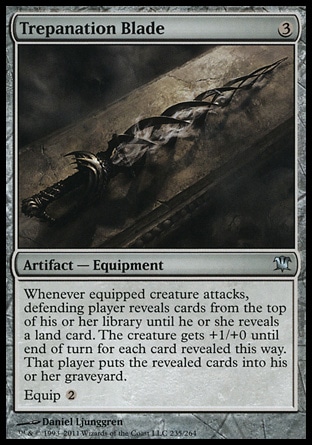
In this article I will answer the question of what the average damage [card]Trepanation Blade[/card] is expected to do is, and all that fun stuff. I'm also going to talk about other stuff that is more interesting about the card than just the average damage.
Suppose that an opponent started the game with 40 cards including 17 lands. By the time we're swinging with [card]Trepanation Blade[/card] we're looking at, at most, 28 cards in his deck and probably around 12 lands remaining (on average he'll draw 5.1 lands in the first 12 cards).
So we swing. Here's what happens:

In this article I will answer the question of what the average damage [card]Trepanation Blade[/card] is expected to do is, and all that fun stuff. I'm also going to talk about other stuff that is more interesting about the card than just the average damage.
Suppose that an opponent started the game with 40 cards including 17 lands. By the time we're swinging with [card]Trepanation Blade[/card] we're looking at, at most, 28 cards in his deck and probably around 12 lands remaining (on average he'll draw 5.1 lands in the first 12 cards).
So we swing. Here's what happens:
I've made a spreadsheet which you can download from Google docs and see all the data for any number of cards in deck and lands in deck between 0 and 60 just by editing those two numbers. It shows the expected number of cards milled, the probability of each number of cards milled, the number of spells that will be left in the deck. You can find the spreadsheet here. If it doesn't play well with your own excel software you can always upload it into google docs again on your own google docs account and play with it there.
The thing that I think is most important about this card (which I don't consider exciting or even terribly playable) is that it's variable. Because of this it's hard to simply analyze it using its average effect. If your opponent is on seven life and you have [card]Trepanation Blade[/card] on a two power creature you need to know how often you activate for five or more, not what your average value on one activation is. Cards like this create a lot of variance in the game, but if you understand the odds you can use them to work out the best play, weighing, say, the chance of activating for five or more against the chance of topdecking one of three outs if you hold back to chump block. Once you know the numbers it's a simple math equation.
The coolest thing? [card]Trepanation Blade[/card] is pretty awful, but in a pinch you could use this spreadsheet for other cards with similar effects like [card]Spoils of the Vault[/card] and [card]Goblin Charbelcher[/card]. For example, with [card]Spoils of the Vault[/card] simply replace the number of lands in your deck with the number of the card you're searching for and you'll see all the possible numbers of cards you could reveal before finding it and how likely this will be. Enjoy!
The thing that I think is most important about this card (which I don't consider exciting or even terribly playable) is that it's variable. Because of this it's hard to simply analyze it using its average effect. If your opponent is on seven life and you have [card]Trepanation Blade[/card] on a two power creature you need to know how often you activate for five or more, not what your average value on one activation is. Cards like this create a lot of variance in the game, but if you understand the odds you can use them to work out the best play, weighing, say, the chance of activating for five or more against the chance of topdecking one of three outs if you hold back to chump block. Once you know the numbers it's a simple math equation.
The coolest thing? [card]Trepanation Blade[/card] is pretty awful, but in a pinch you could use this spreadsheet for other cards with similar effects like [card]Spoils of the Vault[/card] and [card]Goblin Charbelcher[/card]. For example, with [card]Spoils of the Vault[/card] simply replace the number of lands in your deck with the number of the card you're searching for and you'll see all the possible numbers of cards you could reveal before finding it and how likely this will be. Enjoy!
The spreadsheet:
Monday, September 26, 2011
Saturday, September 24, 2011
Draft Structure Value by Winrate
Subscribe to:
Posts (Atom)